Printed surfaces that survive the weather
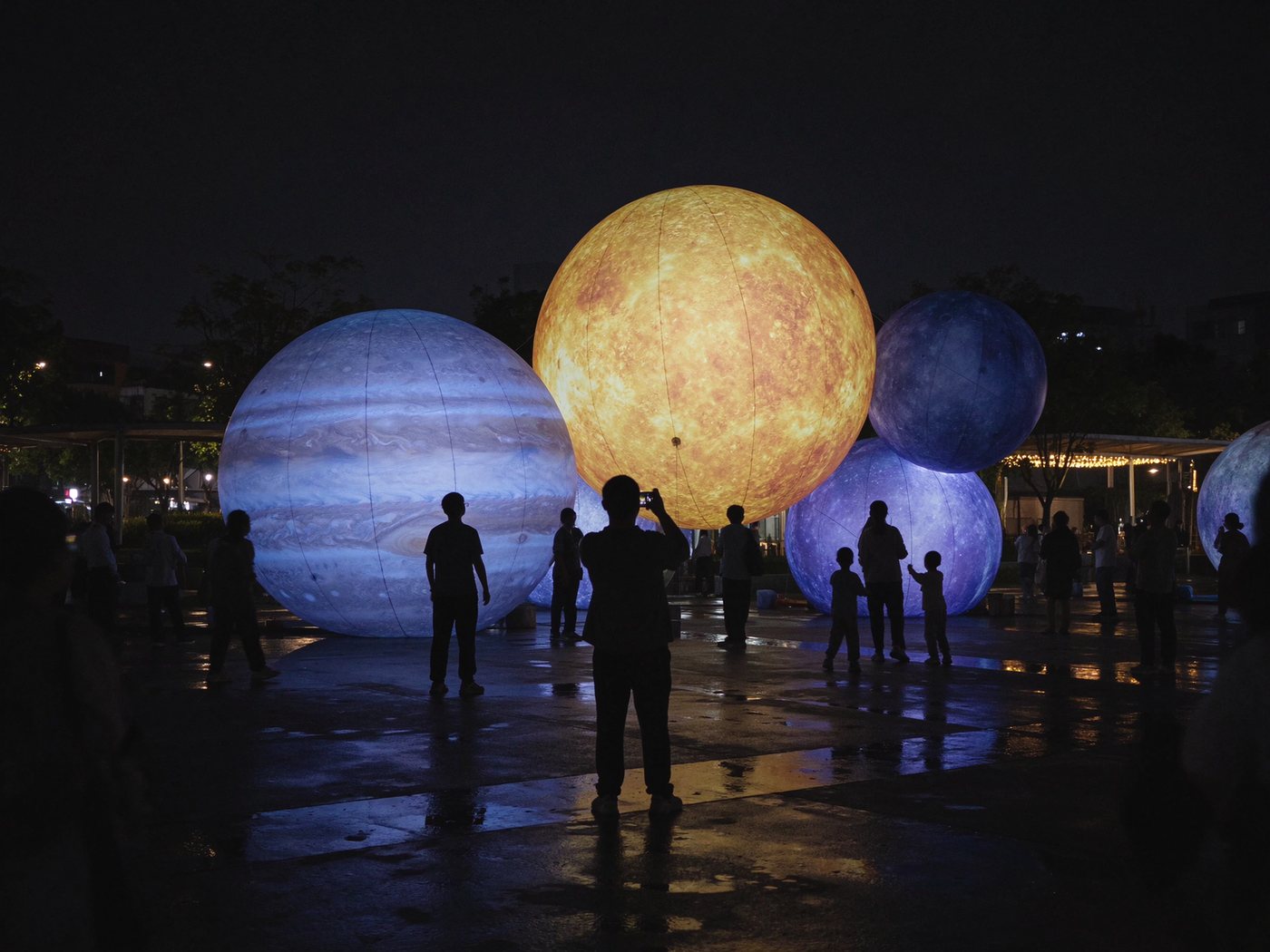
The visual credibility of a planet installation lives in the surface. We print the planetary map onto the coated fabric with UV-resistant pigment, seam-matched across panels so the bands and crater fields run continuously around the sphere. For a solar-system set we scale each body relative to the others and print the same visual language across all of them, which is what makes the group read as one installation rather than six separate balloons.
Internal lighting structure
A 6 m inflatable cannot be lit by one bulb at the base — you get a bright floor and a dark crown. We build an internal light spine or a suspended ring of LED modules, with the modules angled to distribute output across the whole envelope. Colour is controlled per unit through DMX or a simple remote, so a show operator can run a slow rotation between planets or lock the set to a single brand colour.
Engineering that keeps it standing
- High-frequency welded seams, reinforced at every tether anchor point.
- Internal baffles and a load ring so the envelope does not deform under wind.
- Blower and non-return valve sized to the volume, with a pressure-relief port.
- Tether points specified per unit and supplied with ground anchors and a rigging plan.
- Rain drainage at the base and a mould-resistant coating for humid climates.
Deployment and shipping
Units up to 3 m ship deflated in a carton and inflate on site in minutes. Above 4 m we ship with a blower, a tether kit and a printed commissioning sheet that walks your crew through inflation sequence, pressure check and light test. For multi-planet installations we supply a layout drawing showing recommended spacing, anchor positions and the power distribution plan, because the most common on-site failure is not the inflatable — it is the cabling run between them.